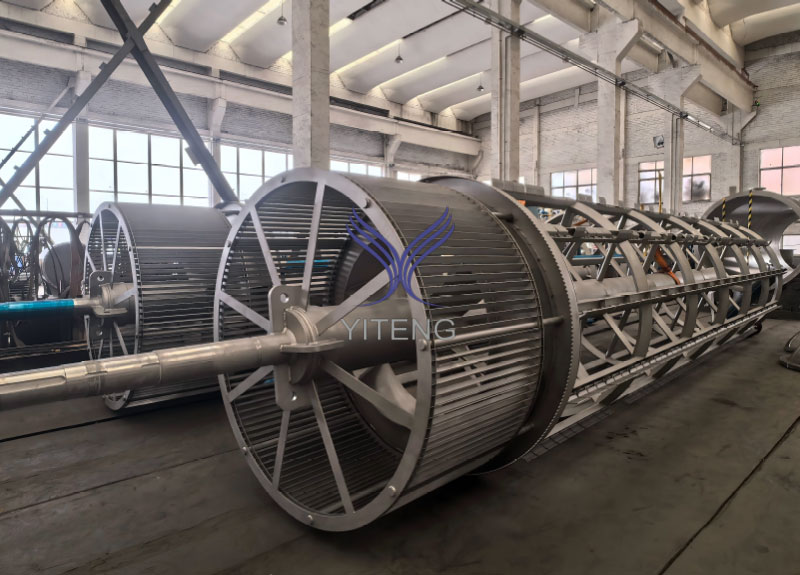
Thin-Film Evaporator Rotor and Wiping System Detailed Explanation
The rotor and wipers are the core transmission components of a thin-film evaporator, directly determining the liquid film quality, heat transfer efficiency, and equipment stability. Below are the technical details:
1.Rotor System Composition
1.Main Shaft Structure:
-
o Material: 316L stainless steel (standard), Hastelloy (highly corrosive conditions), titanium (chloride environments)
-
o Support Method: Upper radial bearing + lower thrust bearing (withstands axial force)
-
o Concentricity Requirement: ≤0.05 mm/m (prevents uneven wiper wear)
2.Drive Configuration:
-
o Motor Type: Explosion-proof variable frequency motor (Ex d IIC T4)
-
o Reduction Mechanism: Planetary gear reducer (torque ≥2000 N·m)
-
o Sealing Type: Double mechanical seal (API 682 standard)
2.Wiper Types and Applications
| Wiper Type | Structural Features | Application Scenarios | Max Viscosity |
| Hinged Wipers | Spring-loaded, self-adapts to wall wear | General purpose (10-10,000 cP) | 20,000 cP |
| Sliding Wipers | Graphite/PTFE bushings, hydraulic assist | High-precision film thickness control (±0.1 mm) | 50,000 cP |
| Fixed Wipers | Rigid connection, no moving parts | Ultra-high viscosity (polymer melts) | 100,000 cP |
| Roller Wipers | Equipped with rollers, reduces friction | Materials with solid particles | 30,000 cP |
3.Key Technical Parameters
1.Linear Speed Control:
-
1.o Standard Range: 2-15 m/s
-
2.o Low Speed (2-5 m/s): High-viscosity materials (>10,000 cP)
-
3.o High Speed (10-15 m/s): Low-viscosity materials (<100 cP)
2.Wiper Pressure Adjustment:
-
o Spring Pressure: 0.1-0.5 Mpa (adjustable)
-
o Hydraulic Pressure: 0.5-3.0 Mpa (high-viscosity conditions)
3.Wear Resistance Design:
-
1.o Wiper Blade Material: Tungsten carbide coating (hardness ≥HRA 90)
-
2.o Shell Lining: Replaceable stainless steel liner (thickness ≥6 mm)
4.Special Design Variants
1.Multi-Layer Wiper Structure:
-
o Staggered upper and lower wipers achieve secondary liquid film distribution (improves heat transfer efficiency by 15-30%)
2.Eccentric Rotor System:
-
o Rotor and shell installed eccentrically to create variable gap shear (suitable for crystallization-prone materials)
3.Heated Rotor:
-
o Thermal oil circulated through the main shaft for double-sided heating (used for ultra-high viscosity materials)
5.Maintenance and Monitoring
1.Online Monitoring Points:
-
o oVibration Monitoring: Shell-mounted vibration sensors (threshold ≤4.0 mm/s)
-
o Torque Monitoring: Motor current feedback indicates wiper resistance (clogging warning)
-
o Temperature Monitoring: Bearing temperature (≤80°C)
2.Routine Maintenance Items:
-
o Wiper Replacement: Required when blade wear >1 mm (typically every 500-2000 operating hours)
-
o Seal Inspection: Adjust mechanical seal if leakage >10 mL/h
-
o Concentricity Calibration: Check shaft straightness annually
6.Troubleshooting Guide
| Symptom | Possible Cause | Solution |
| Current Fluctuation | Sudden viscosity change or clogging | Adjust speed/clean equipment |
| High Product Residue | Wiper wear or insufficient pressure | Replace wipers/adjust spring pressure |
| Abnormal Noise/Vibration | Bearing damage or rotor imbalance | Shut down and check dynamic balance |
By optimizing the rotor and wiper design, thin-film evaporators can handle a wide range of materials from low-viscosity solvents to high-viscosity polymers, making them a key technology for precision separation.

 中文
中文


