
 中文
中文

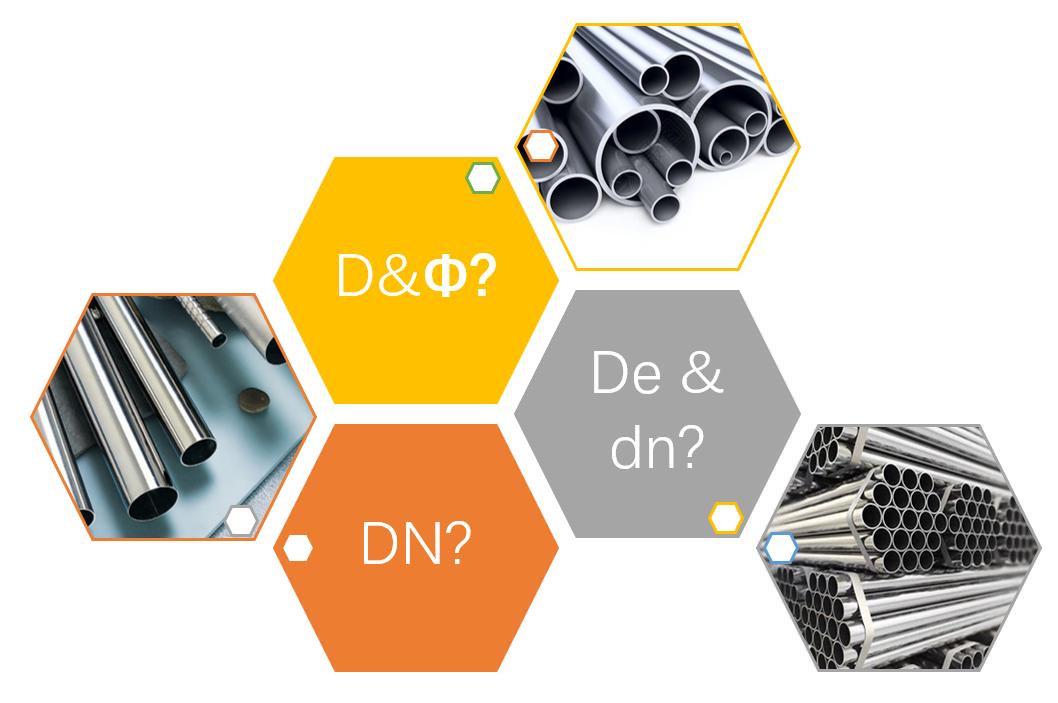
Understanding Pipe Specifications: DN, Inch, D, De, Φ, dn, and d
 Introduction
In the world of piping systems, understanding the various specifications and terminologies used to describe pipe dimensions is crucial for engineers, technicians, and procurement professionals. This article aims to demystify the common notations used in pipe specifications, including DN, inch, D, De, Φ, dn, and d, and explain their specific meanings and applications.
1. DN (Nominal Diameter)
· Definition: DN stands for Nominal Diameter, which is a standardized diameter used in pipe engineering. It is neither the outer diameter nor the inner diameter but a nominal size that closely approximates the actual dimensions of the pipe.
· Application: DN is widely used in engineering design and construction to facilitate the selection and matching of pipes and fittings. For example, a DN100 pipe typically corresponds to an outer diameter of 108 mm, with the inner diameter varying depending on the wall thickness.
2. Inch
· Definition: Inch is an imperial unit of length commonly used to denote the nominal diameter of pipes. For example, 1/2", 3/4", and 1" are common pipe sizes that correspond to specific DN values.
· Conversion: 1 inch = 25.4 mm. Therefore, 1 inch (1") corresponds to DN25. In the imperial system, 1 inch equals 8 divisions, so 1/2" (4 divisions) corresponds to DN15, and 3/4" (6 divisions) corresponds to DN20.
3. D (Outer Diameter)
· Definition: D represents the outer diameter of the pipe. It is often used in conjunction with wall thickness to specify pipe dimensions, such as D108×4, which indicates a pipe with an outer diameter of 108 mm and a wall thickness of 4 mm.
· Application: This notation is commonly used in mechanical manufacturing and petrochemical industries where precise dimensions and strength are critical.
4. Φ (Diameter Symbol)
· Definition: Φ is used in engineering to denote the diameter of a circle. When used for pipes, it is similar to D and indicates the outer diameter. For example, Φ108×4 represents a pipe with an outer diameter of 108 mm and a wall thickness of 4 mm.
· Application: This notation is frequently used for seamless steel pipes and non-ferrous metal pipes.
5. De (External Diameter)
· Definition: De stands for External Diameter and is primarily used for the nominal outer diameter of plastic pipes in building water supply and drainage systems. It is denoted in millimeters and is specified in the format "outer diameter × wall thickness." For example, De25×3 indicates a pipe with an outer diameter of 25 mm and a wall thickness of 3 mm.
· Application: De is commonly used in plastic pipe standards in China.
6. dn (Nominal Diameter for Plastic Pipes)
· Definition: dn is used to denote the nominal outer diameter of plastic pipes, similar to De. It is more commonly used in European standards or ISO standards. For example, dn50 indicates a plastic pipe with a nominal outer diameter of 50 mm.
· Application: This notation is widely used in international standards for plastic pipes.
7. d (Inner Diameter)
· Definition: d represents the inner diameter of pipes, such as concrete pipes and clay pipes. It is the internal diameter of the pipe. For example, d300 indicates a concrete pipe with an inner diameter of 300 mm.
· Application: This notation is crucial for pipes where the inner diameter is a primary design parameter, especially for determining flow rates and velocities.
Differences in Usage
1. Scope and Standard Systems
· DN: Widely used in China and many international standards for various types of pipes (steel, cast iron, plastic) in fields such as water supply, heating, ventilation, and gas.
· D and Φ: Commonly used in domestic and international standards for metal pipes, especially in mechanical manufacturing and petrochemical industries.
· d: Primarily used for traditional pipes like concrete and clay pipes where the inner diameter is a key design parameter.
· De and dn: Commonly used in plastic pipe standards, with De being more prevalent in China and dn in European standards.
· Inch: Used in countries and regions that follow imperial standards, as well as in international projects that adopt imperial units.
2. Emphasis
· DN: Focuses on standardizing pipe and fitting sizes for ease of design, manufacturing, and installation.
· D, Φ, De, dn: Emphasize the actual outer diameter, which is critical for manufacturing, installation, and dimensional control.
· d: Highlights the inner diameter, which is essential for calculating flow rates and velocities.
· Inch: Facilitates compatibility with other imperial units in systems that use imperial standards.
 Conclusion
Understanding the various notations used in pipe specifications is essential for ensuring the correct selection and compatibility of pipes and fittings in engineering projects. Whether you are working with metric or imperial units, knowing the distinctions between DN, D, De, dn, and d can help you make informed decisions and avoid costly mistakes.
ABOUT YITENG
PRODUCTS
CONTACT US
Wuxi Yiteng Pressure Vessel Co, Ltd.

Hello, I'm Aurora,a passionate B2B specialist. I'm here to guide you from concept to completion. Let's discuss how we can meet your project's exact requirements. Don't hesitate to reach out!


