
 中文
中文

Duplex Stainless Steel: A Comprehensive Analysis of Advantages and Challenges
Abstract: Duplex Stainless Steels (DSS), characterized by their unique ferritic-austenitic microstructure, combine high strength with excellent corrosion resistance, making them an ideal material choice for demanding environments in chemical, marine, and energy industries. This article systematically analyzes their performance advantages and limitations to aid in precise material selection.
1. What is Duplex Stainless Steel?
Duplex Stainless Steel (DSS) is a family of stainless steels whose microstructure consists of approximately equal proportions of ferrite and austenite (typically with the minority phase being at least 30%). Through precise control of alloying elements like Chromium (Cr: 18%–28%), Nickel (Ni: 3%–10%), Molybdenum (Mo), and Nitrogen (N), along with heat treatment, it successfully integrates the advantages of both ferritic and austenitic steels. Since their inception in the 1940s, they have evolved to a third generation.
2. Key Performance Advantages
1. Excellent Mechanical Properties
· High Strength: Yield strength ranges from 400 to 550 MPa, which is twice that of conventional austenitic stainless steels (e.g., 304), allowing for reduced wall thickness, lighter equipment, and lower manufacturing costs.
· Good Toughness and Ductility: Elongation can exceed 25%, accompanied by high impact toughness and fatigue strength.
2. Outstanding Corrosion Resistance
· Superior Resistance to Stress Corrosion Cracking (SCC): Particularly in chloride-containing environments, performance is far better than austenitic grades like 304 and 316.
· Excellent Pitting and Crevice Corrosion Resistance: High Pitting Resistance Equivalent (PRE) numbers make them stand out in aggressive media (e.g., seawater, chemical solutions).
· Good Resistance to Corrosion Fatigue and Erosion-Corrosion: Suitable for moving components like pumps and valves.
3. Favorable Fabrication and Physical Properties
· Good Weldability: Low hot cracking susceptibility; typically, preheating and post-weld heat treatment are not required.
· Advantageous Physical Properties: Thermal conductivity is superior to austenitic steels, and the coefficient of thermal expansion is close to carbon steel, making them suitable for cladding, heat exchangers, etc.
3. Challenges and Limitations
1. Temperature Limitations: Continuous service temperature is generally limited to 250°C to avoid embrittling phase precipitation.
2. Fabrication Challenges: Pronounced work hardening during cold working; hot working (especially for high-alloy grades) is more challenging than for austenitic steels.
3. Process Sensitivity: Properties are sensitive to heat treatment and welding parameters; improper control can lead to precipitation of harmful phases, reducing toughness and corrosion resistance.
4. Cost Considerations: Higher content of alloying elements (especially Nickel and Molybdenum) typically results in a higher initial material cost compared to standard austenitic and ferritic grades.
4. Common Grades and Applications
|
Type |
Typical Grade (UNS) |
Primary Applications |
|
Lean Duplex |
S32304 |
Water treatment systems, Heat exchangers |
|
Standard Duplex (2205) |
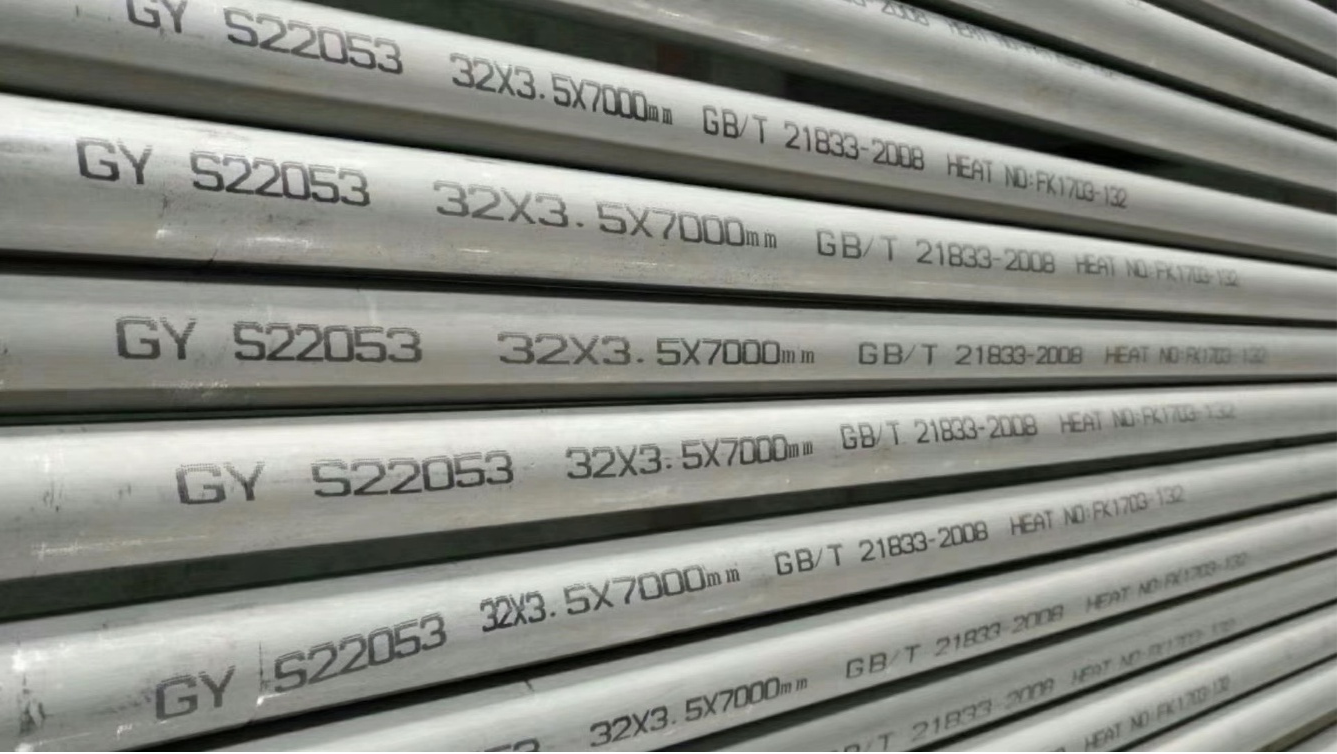
S31803/S32205 |
Oil & gas pipelines, Chemical containers |
|
High-Alloy Duplex |
S32550 |
Chemical processing equipment (acidic environments), Seawater handling |
|
Super Duplex |
S32750 (2507) |
Subsea oil fields, High-chloride environments |
5. Comparative Material Selection
|
Comparison |
Key Advantages |
Key Limitations |
|
vs. Austenitic Stainless Steel |
Twice the yield strength, Excellent chloride SCC resistance, Thermal expansion similar to carbon steel |
Lower maximum service temperature, More challenging fabrication, Higher cost |
|
vs. Ferritic Stainless Steel |
Significantly better toughness, Superior weldability, Better overall corrosion resistance |
Higher alloy cost (ferritics are often Ni-free and cheaper) |
Conclusion
Duplex Stainless Steels achieve an outstanding balance of strength, corrosion resistance, and cost-effectiveness through their unique two-phase microstructure. Despite limitations in fabrication and high-temperature applications, their superior overall performance in corrosive environments makes them a critical material across various industries. Correct grade selection and strict process control are key to unlocking their full potential.
ABOUT YITENG
PRODUCTS
CONTACT US
Wuxi Yiteng Pressure Vessel Co, Ltd.

Hello, I'm Aurora,a passionate B2B specialist. I'm here to guide you from concept to completion. Let's discuss how we can meet your project's exact requirements. Don't hesitate to reach out!


