
 中文
中文

A Practical Guide to Gasket Selection for Pressure Vessels: Balancing Material Properties and Operating Conditions
Gaskets are critical components in flange sealing systems for pressure vessels, directly impacting safety and reliability. Designers must balance factors such as media corrosivity, temperature/pressure ranges, and cost constraints. This article provides a systematic analysis of gasket materials, selection criteria, and international standards to support optimal design decisions.
1. Classification of Gasket Materials and Basic Selection Principles
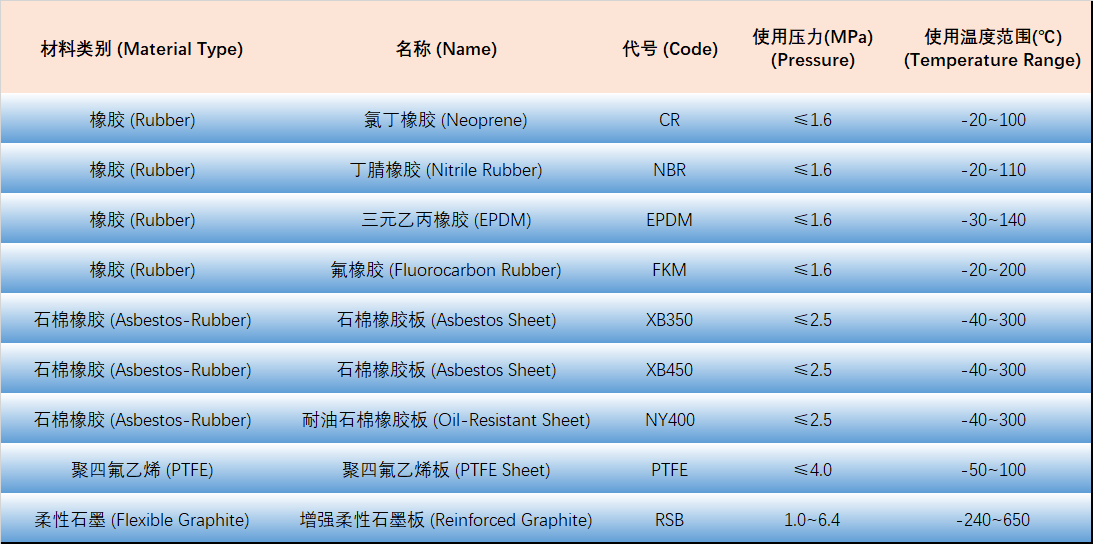
Gasket materials must be compatible with media chemistry, temperature-pressure limits, and flange structures. Common materials include rubber, PTFE, and flexible graphite, with typical applications as follows:
· Rubber Gaskets: NBR for seawater and steam below 110°C; EPDM for wet chlorine, hydrochloric acid.
· Asbestos-Rubber Sheets: Restricted internationally due to environmental concerns.
· Reinforced Graphite: Resistant to extreme temperatures (-240~650°C), suitable for cryogenic or high-temperature services.
· PTFE: Excellent chemical resistance but limited by temperature and pressure.
Refer to the following table for key parameters:
2. Critical Considerations for Special Conditions**
1. High-Temperature/Pressure Services:
o Unbound high-strength graphite gaskets are prohibited for gaseous media or high pressure;
o Applications with thermal cycling require resilient gaskets (e.g., serrated metal composite or spiral-wound with rings).
2. Corrosive Media:
o Asbestos-rubber gaskets are banned for toxic or highly corrosive media;
o Chloride content in graphite gaskets for stainless steel flanges must be ≤50ppm.
3. Flange Compatibility:
o Semi-metallic gaskets for PN≤1.6MPa flanges require rigid structures (e.g., weld-neck flanges).
3. Advanced Applications of PTFE Gaskets
PTFE gaskets include standard (PTFE), filled (RPTFE), and expanded (ePTFE) types, offering superior chemical resistance. Key examples:
· ePTFE Gaskets: Operate at -200~260°C, resistant to NaCl, HCl, etc.;
· International Brands: GORE-TEX (up to 315°C), Garlock 3500 series (FDA-compliant for acids/alkalis) provide solutions for demanding conditions.
4. Metal Serrated Composite Gaskets: Advantages and Trends
Metal serrated composite gaskets maintain stability at 700°C and 25MPa, increasingly replacing spiral-wound gaskets in high-temperature applications (e.g., hydrogen reactors, refinery heat exchangers). Key benefits include:
· Anti-Collapse: Avoids unravelling or crushing issues common in spiral-wound gaskets;
· Thermal Cycle Resilience: Excellent recovery under fluctuating conditions.
Conclusion
Gasket selection is a decisive factor in pressure vessel design, requiring alignment with standards (e.g., HG/T 20583) and practical operating conditions. Future advancements in high-performance materials and smart selection tools will further enhance sealing system safety and economy.
ABOUT YITENG
PRODUCTS
CONTACT US
Wuxi Yiteng Pressure Vessel Co, Ltd.

Hello, I'm Aurora,a passionate B2B specialist. I'm here to guide you from concept to completion. Let's discuss how we can meet your project's exact requirements. Don't hesitate to reach out!


