
 中文
中文

Exploring the Key Manufacturing Processes of Pressure Vessels
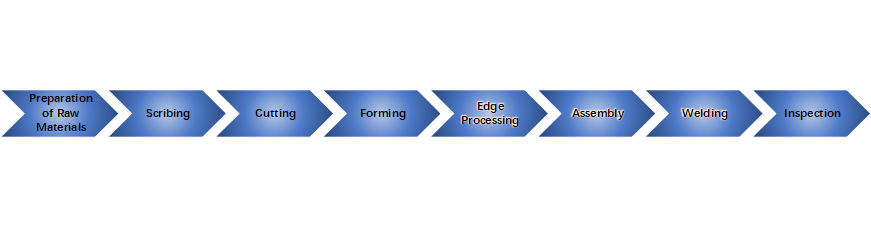
At our company, we are committed to delivering high-quality stainless-steel containers, and understanding the intricate manufacturing processes involved is crucial to achieving this goal. We will delve into the main manufacturing processes of pressure vessels, which are also highly relevant to our fabrication, by 2 articles.
(meets preceding text)
Edge Processing
Edge processing refers to the operations performed on the edges of components to ensure they are smooth, flat, and free from burrs and sharp edges. This process enhances the overall quality and safety of the product. Common Edge Processing Methods:
Milling: Milling machines are used to remove excess material from the edges, achieving the desired dimensions and shape.
Grinding: Grinding machines smooth out burrs and sharp edges, resulting in a polished surface.
Turning: For circular or shaft-type components, lathes are employed to process the edges.
Hand Grinding:
Sandpaper or grinding wheels are used to smooth areas that are difficult to reach with machinery, ensuring edge smoothness.
Chemical Treatment:
Pickling and Passivation: Chemical solutions are used to remove oxide scale and rust from the edges while forming a protective passivation film to enhance corrosion resistance.
Laser Cutting:
Laser cutting precisely controls the shape and quality of the edges during the cutting process, resulting in smooth edges that require no additional grinding.
Assembly is the process of combining processed parts into a complete product according to design specifications. The quality of the assembly process directly affects the performance and reliability of the product.
Assembly Process Design:
Determine the optimal assembly plan, including the division of assembly units, assembly sequence, and assembly reference points.
Assembly Positioning Methods:
Scribing Positioning Method: Use scriber tools to mark positioning lines on parts, suitable for simple part positioning.
Reference Part Positioning Method: Use certain points or lines on parts as references to determine the positions of other parts.
Positioning Hole Positioning Method: Process positioning holes on parts and use them to determine the relative positions of parts.
Assembly Fixture Positioning Method: Use specialized fixtures to hold parts in place, ensuring assembly accuracy.
Assembly Connection Methods:
Mechanical Connection: Use fasteners such as bolts, screws, and rivets to join parts together.
Welding: Heat is applied to create permanent connections between parts, suitable for areas requiring high strength.
Adhesive Bonding: Use adhesives to bond parts together, suitable for applications requiring sealing or lightweight construction.
Assembly Measurement and Inspection:
Use contact or non-contact measuring tools (such as coordinate measuring machines, optical measuring instruments) to measure the geometric dimensions and positional accuracy of the assembled product.
Inspect physical quantities (such as assembly force, deformation, residual stress) and status quantities (such as sealing performance, interference conditions) after assembly.
By carefully designing the assembly process and strictly performing edge processing, we can ensure the high quality and performance of our stainless-steel containers, meeting the strict requirements of our customers.
Welding is a crucial process in the manufacturing of pressure vessels and involves joining materials by heating or applying pressure, or a combination of both, to achieve atomic bonding and create a permanent joint. Approximately 50% of the world's annual steel consumption involves welding processes. There are three main types of welding:
Fusion Welding
Fusion welding involves locally heating the workpieces to be welded until they melt. Upon cooling and solidification, a weld seam is formed, joining the components together. This category includes arc welding, gas welding, electroslag welding, electron beam welding, and laser welding. Fusion welding is widely used for most low-carbon and alloy steels and can also be applied to non-metals like ceramics and glass in specialized applications.
Pressure Welding
Pressure welding requires the application of pressure during the welding process, with or without heating. The purpose of heating in pressure welding is to soften the metal, allowing plastic deformation and bringing the atoms close enough to form a strong bond. This is fundamentally different from the heating in fusion welding. Pressure welding methods include resistance welding, friction welding, ultrasonic welding, cold pressure welding, explosive welding, diffusion welding, and magnetic pulse welding. These methods offer advantages such as minimal welding deformation, fewer cracks, and ease of automation.
Brazing
Brazing involves heating a filler metal with a lower melting point than the base material until it melts. The molten filler metal fills the joint, wets the base material, and diffuses with it to form a unified joint. Brazing is divided into two main categories: hard brazing and soft brazing. Hard brazing has a heating temperature above 450°C and a tensile strength greater than 200 MPa. It often uses silver-based or copper-based filler metals and is suitable for applications with high working stress and elevated temperatures, such as welding hard metal cutting tools and geological drill bits. Soft brazing has a heating temperature below 450°C and a tensile strength less than 70 MPa. It is suitable for low-stress and low-temperature environments, like soldering in electrical circuits.
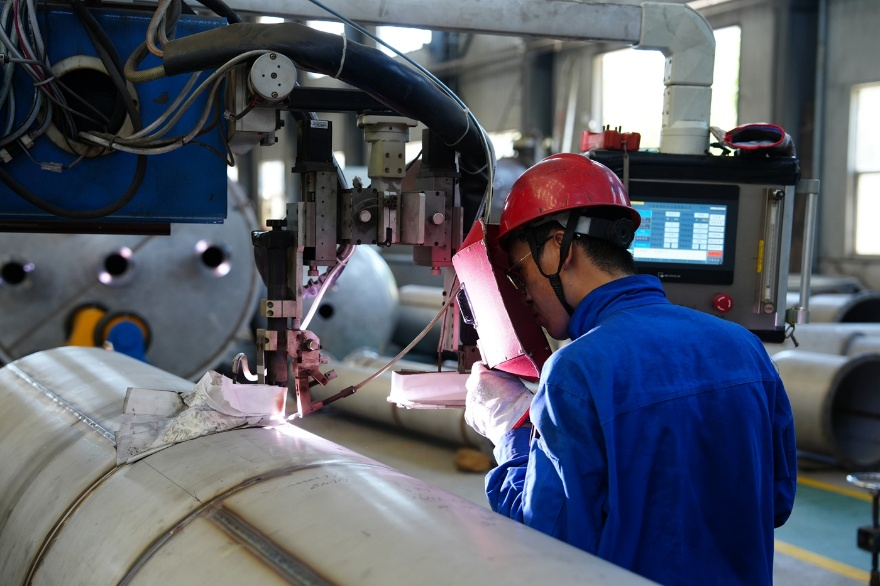
Understanding these key manufacturing processes allows us to better control the quality of our stainless-steel containers. From the careful preparation of raw materials to precise scribing, efficient cutting, accurate forming, and reliable welding, each step contributes to the final product's performance and durability. At our company, we continuously strive to optimize these processes to meet the highest standards and deliver exceptional stainless-steel containers to our customers.
ABOUT YITENG
PRODUCTS
CONTACT US
Wuxi Yiteng Pressure Vessel Co, Ltd.

Hello, I'm Aurora,a passionate B2B specialist. I'm here to guide you from concept to completion. Let's discuss how we can meet your project's exact requirements. Don't hesitate to reach out!


